








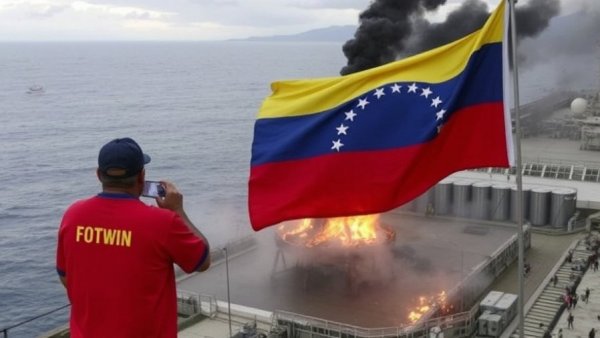
Unraveling the Flow of Venezuelan Oil: Who Truly Benefits?
The significant uptick in Venezuela's oil production has sparked considerable attention, especially as the United States emerges as the leading recipient of these exports. Under a new arrangement that places oil revenues under U.S. control, the murky waters of accountability and transparency present a daunting challenge. The situation raises critical questions about who genuinely benefits from Venezuela's lucrative oil wealth amidst ongoing concerns about corruption and the lack of financial oversight.
A Melodramatic History: Oil and Power Dynamics
As the global stage plays out like a serialized drama, events from the past few years have led to unprecedented occurrences in Venezuela. The capture of former President Nicolás Maduro, portrayed in stark images and charged with political implications, underscores the shifting power dynamics. This particular event, while shocking, is emblematic of the broader narrative surrounding Venezuela's oil wealth: a complex interplay of political maneuvering and economic exploitation.
The resulting changes in leadership, spearheaded by an interim government led by Delcy Rodríguez, have ushered in a new era of U.S.-Venezuelan relations, with increased diplomatic exchanges since March. Despite this transition, the flow of oil northwards continues, a paradox in the midst of political upheaval.
The Current State of Venezuelan Oil Exports
Venezuela, sitting atop the globe’s most extensive oil reserves, is often regarded as an oil gold mine with 17% of the world's total. Yet a significant portion of this treasure lies dormant due to systematic mismanagement and the constraints of U.S. sanctions. With the country’s production recently surging to 1.2 million barrels per day (bpd), the U.S. has quickly become the top importer, consuming 43% of Venezuelan oil exports, followed closely by India and Spain.
Still, despite beneficial circumstances, the Venezuelan economy appears trapped in a cycle of volatility. The International Monetary Fund (IMF) predicts a 5% growth, counterbalanced by an inflation spike reaching 467.9%, the highest in Latin America. This financial discrepancy reveals an alarming truth: Venezuela's economy is not reaping the rewards of its oil production, primarily due to the complicated logistics of oil payments.
Economic Vulnerabilities: The Devaluation of the Bolívar
The connection between oil exports and local economic stability is particularly tenuous. Although increased oil output could theoretically enhance GDP, a significant portion of Venezuelan oil is exported in unrefined form, which doesn't translate into direct economic benefits for the populace. Even with rising oil revenues, the bolívar’s value continues to plummet, suggesting systemic issues within economic management.
Since Maduro's ousting, revenues from the oil sales are funneled into U.S. Treasury accounts, controlled tightly by U.S. authorities. This arrangement allows U.S. Secretary of State Marco Rubio to dictate how oil revenues are allocated back to Venezuela. Such measures could further entrench reliance on U.S. oversight, contributing to the ongoing financial instability and inflation setting a cyclical precedent for economic misgivings.
Understanding the Complex Payment Structure
Under the new energy accord enacted in January by Trump, the U.S. has the authority to manage sales of Venezuelan oil, deposit the proceeds in controlled accounts, and disburse them only with explicit permission. This method of payment is indirect, requiring Venezuela to submit budgetary requests to the State Department. This opaque mechanism connects back to the convoluted banking system in Venezuela, where U.S. dollars filtered into local banks and sold to businesses reflects a convoluted structure that further entrenches instability.
The Road Ahead for Venezuelan Oil and Its Impact on US Relations
As oil continues to flow from Venezuela to the United States, geopolitical implications grow. The border between economic necessity and political maneuvering blurs, creating a labyrinthine narrative of power. Notably, as the stage is set for potential political change in Venezuela, with presidential elections on the horizon, the relationship between oil exports and political stability will remain focal points for observers.
The outlook remains mixed, with manufacturers and import-export companies navigating this complex terrain, balancing tariffs and trade relations amidst a backdrop of fluctuating policies. With the stakes so high, stakeholders are advised to stay informed and proactive, ensuring they can mitigate risks associated with this tenuous situation...




Write A Comment