








Did you know the global minerals market shifted past $1.5 trillion in 2023—but just eight countries control over 70% of the world’s critical mineral supply chains? These facts only scratch the surface of a sector shaped by fierce geopolitical chess matches, technological disruptions, and the soaring demand for minerals that fuel our everyday technology. In this in-depth analysis, we pull back the curtain on the realities behind the headlines, exposing shifts in market size , the dynamic strategies of global mining giants, and the untold risks and opportunities driving tomorrow’s minerals market.
The Global Minerals Market: Unconventional Facts and Startling Statistics
-
The global minerals market surpassed $1.5 trillion in value in 2023, yet few realize the volatile shifts behind this figure.
-
Only 8 countries control over 70% of critical mineral supply chains worldwide.

"Resource nationalism is redrawing the map of global mineral supply—what worked a decade ago is rapidly changing."
What You'll Discover About the Global Minerals Market
-
Hidden economic and geopolitical forces shaping mineral markets
-
The impact of critical minerals on global mining policy
-
Why market size and share data often mislead investors
-
New frontiers and risks in the minerals market
Global Mining Insights: A Deep Dive Into the Minerals Market’s Evolution
Tracing the Global Mining Industry: How Did We Get Here?
-
From coal and iron ore to lithium and cobalt: a changing priority
-
The role of technology in modern mineral extraction
The global mining industry has undergone a dramatic transformation. Decades ago, iron ore and coal extraction defined industrial powerhouses such as North America and the bustling economies of Asia Pacific . But now, the surge in digital innovation and the global push for renewables are on center stage. The importance of rare earth elements , lithium, and cobalt has overtaken traditional minerals, driven by the relentless demand for electronics, electric vehicles, and clean energy solutions. This change in priority has forced even established key players like Rio Tinto and BHP to pivot strategies, seeking out resource-rich regions in Africa, South America, and the Middle East to meet surging demands.
Meanwhile, technology's role continues to accelerate the sector’s evolution. Advanced drilling, AI-driven exploration, and remote operation platforms have redefined how mines operate—pushing the boundaries of what’s economically viable. Modern extraction techniques can pinpoint previously inaccessible deposits, increasing the efficiency of the global mineral market . As supply chain visibility improves and digitization becomes mainstream, countries are vying not just for resources but for dominance across entire mineral supply chains .

These shifts in global mining priorities are also reflected in recent international agreements, such as the new minerals deal between the US and Ukraine, which is poised to influence import-export dynamics and reshape supply chain strategies for companies worldwide. For a closer look at the implications of this partnership, explore the US-Ukraine minerals deal and its impact on import-export companies .
Minerals Market Size: Surpassing Historical Benchmarks
The market size of the minerals market has consistently set new records over the past decade. From $1 trillion in 2015 to an impressive $1.5 trillion in 2023, growth is being propelled by both old and new demand drivers. While construction and heavy industry still create a stable base, the explosive growth of clean energy, electric mobility, and consumer electronics has shifted the focus to critical minerals like lithium, nickel, and cobalt. Investors and governments worldwide recognize these trends as indicative of ongoing market growth and new market opportunities .
A close look at year-on-year expansion reveals not just a meteoric rise in value, but also substantial volatility. The trajectory suggests that while total market value will continue to incline, market shocks—be they from political instability, price wars, or rapid tech rollouts—remain an ever-present risk. Understanding the forces behind these numbers is essential for investors and policymakers navigating the unpredictable rhythms of the global market .
|
|
Global Minerals Market Size Over Time |
|
Year |
Market Size (USD Trillion) |
|---|---|
|
2015 |
1.0 |
|
2020 |
1.3 |
|
2023 |
1.5 |
Shifting Market Share: Dominance of Key Players in the Global Mineral Arena
-
China’s exponential growth in rare earths
-
Australia's grip on lithium production
-
The rise of Africa and Saudi Arabia in critical minerals
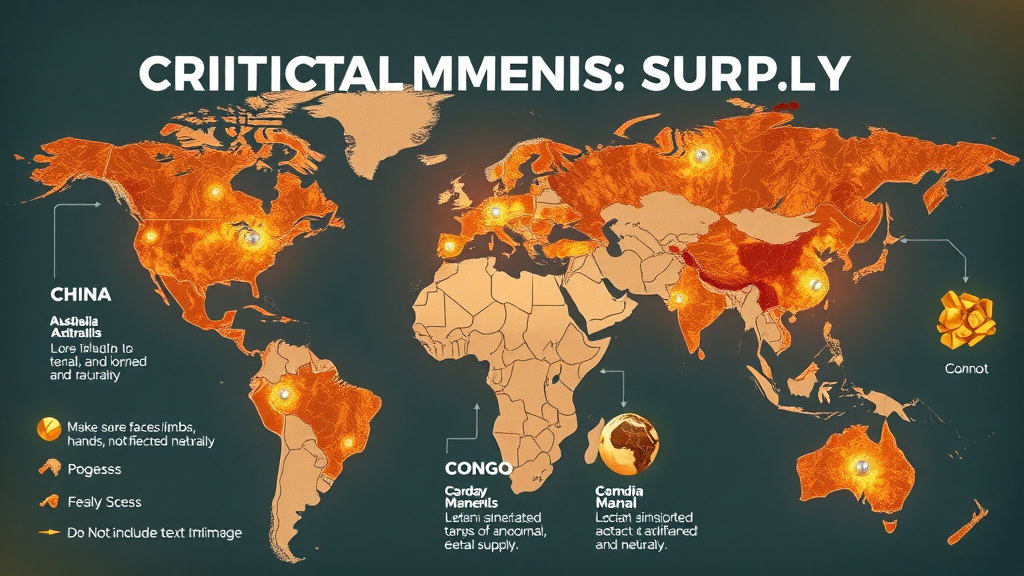
The market share of major mineral-exporting nations has shifted dramatically in recent years, a fact often overlooked in discussions about the global mining sector . China is a behemoth in the rare earth elements landscape, wielding control over a lion’s share of the world’s processed supply. Australia, with its massive reserves and investments in lithium and gold, holds a commanding position for supplying critical raw materials to both Western and Asian markets.
Emerging economies, especially across Africa and the Middle East (notably Saudi Arabia ), are rapidly increasing their influence. The Democratic Republic of Congo, for instance, produces much of the globe's cobalt, while Saudi Arabia is investing heavily to become a leading supplier of phosphate and gold. These changes are redrawing the map of mineral supply , compelling traditional powers to innovate or risk diminishing relevance in an increasingly fragmented global minerals market .

Why the Demand for Critical Minerals Is Rewriting Global Market Rules
Critical Minerals and Their Role in Clean Energy Transitions
-
The soaring demand for cobalt, lithium, and nickel
-
Electric vehicles and battery innovations fueling new mineral booms
As the world embarks on a historic shift towards decarbonization, critical minerals such as lithium, cobalt, and nickel have become as strategically vital as oil once was. Propelled by expanding market opportunities in the electric vehicle (EV) and battery storage sectors, demand for these minerals has reached unprecedented highs. Companies, governments, and supply chain strategists are racing to secure access, often leading to supply chain battles and tense international negotiations.
The emergence of EV megafactories and ever-larger renewable energy installations directly drives the market size for these commodities. As a result, whole regions—especially in Africa, Australia , and South America —have rapidly scaled production and infrastructure. This shift has broader implications for mining policy, international regulations, and the way countries safeguard their role in the clean energy revolution.

Political Gambits and Supply Chain Battles for Mineral Market Share
Countries aren’t just competing for minerals—they’re future-proofing their economies. In the modern economy, commanding the flow of critical minerals equates to controlling the technologies of tomorrow. The geopolitical contest is as intense as ever: from the U.S. invoking resource security in defense planning, to China’s formidable grip on processing rare earths and the EU’s push for diversified mineral supply chains .
Emerging policies, such as resource nationalism and bilateral trade deals, create volatility in market share statistics and can upend global supply networks overnight. As a result, traditional alliances are giving way to pragmatic, opportunistic partnerships built to weather price spikes, export controls, and other shocks. For any organization or investor tracking the minerals market , it’s critical to recognize that the balance of power is more in flux than ever.
"Countries aren’t just competing for minerals—they’re future-proofing their economies."
Underrated Trends: Innovations Changing the Global Minerals Market
Technological Disruption in Global Mining
-
AI-driven exploration tools improving mineral discovery rates
-
The shift toward remote, automated mining operations
The adoption of digital technology has disrupted the mining industry as thoroughly as any sector. From satellite surveys to AI-driven geophysics, technology is enabling faster and more accurate discovery of new deposits. Mining giants—especially in Asia Pacific and North America—are using data sensors, machine learning, and robotics to increase safety, minimize waste, and cut labor costs, transforming the global mineral production landscape.
Remote operations centers manage entire fleets of autonomous trucks and drilling rigs in real time, bringing a new era to the global minerals market . These automated systems not only reduce operating expenses and environmental impacts, but also improve adaptability in regions afflicted by political or logistical difficulties. As digitization accelerates, expect rapid shifts in market share as companies with tech-savvy strategies outmaneuver slower-moving competitors.

Sustainability and the New Rules of Global Mineral Production
-
ESG (Environmental, Social, and Governance) is now a core mining industry standard
-
The impact of green technologies on traditional minerals market
No longer is profitability in the mineral market measured solely by tonnage or market price. Today, companies must also address their environmental footprint, social responsibility, and governance standards—collectively known as ESG. Global mining companies are now pillars of transparency and compliance, responding to investor and community demands for ethical sourcing, local benefit sharing, and lower-carbon operations.
The adoption of green technologies—such as power from renewables, electric mining fleets, and comprehensive waste management—has begun to erode the dominance of traditional mining hubs. As new regulations tighten and consumer awareness increases, ESG is no longer just a buzzword but a precondition for accessing international markets and winning long-term contracts. Investors seeking sustainable growth view compliance as a primary growth driver, and sustainable mining operations now serve as a benchmark for the modern minerals market .
Mineral Market Forecast: What Lies Ahead for the Global Minerals Market
Key Catalysts for Growth: New Markets, New Risks
-
Expansion in emerging economies
-
Political instability and mineral nationalism
The coming years will see the global minerals market fueled by aggressive demand from emerging markets, especially as nations like India and various countries across Africa and the Middle East industrialize at record pace. However, this expansion brings inherent risks—chief among them are unpredictable regulatory changes, surging resource nationalism, and political instability in mining jurisdictions.
At the same time, ongoing advances in green technology and high-tech manufacturing will sustain the premium on critical minerals . Market watchers predict ongoing volatility; while the upside potential is immense, so too are the risks of supply chain disruptions, geopolitical tensions, and abrupt changes in market share . Adaptability, robust supply agreements, and transparent sourcing are set to define the winners and losers of the next decade.
Marketing Strategies in the Global Minerals Market
-
Data-driven pricing
-
Direct negotiations versus spot markets
As the global mineral market grows more competitive, the methods companies use to price and market their products are evolving. Data analytics allows firms to better anticipate price movements, demand spikes, and inventory allocation, leading to a rise in dynamic, data-driven pricing strategies. Rather than relying exclusively on traditional spot markets, major key players now negotiate directly with end-users—ensuring stable, long-term contracts and insulating themselves from market volatility.
At every tier of the supply chain , granular market intelligence is vital. From small explorers to industry giants like Rio Tinto and BHP, adapting marketing strategies to rapidly shifting consumer and regulatory trends is paramount. Whether leveraging direct trade deals or online auction platforms, success in the minerals market now depends on agility, foresight, and leveraging real-time data for every transaction.
Watch this expert video breakdown to see how critical minerals like lithium and cobalt shape global mineral supply chains, impacting everything from geopolitics to technology development.
People Also Ask
How big is the global mineral market?
The global mineral market topped $1.5 trillion in 2023, with an annual growth rate averaging 5% since 2018, reflecting accelerating demand for critical minerals driven by technology and clean energy sectors.
What minerals are in great demand?
Currently, lithium, cobalt, nickel, copper , and rare earth elements are in the highest demand due to their essential role in electronics, renewable energy technologies, and electric vehicles.
Which country has the biggest supply of critical minerals?
China dominates the supply of several critical minerals , especially rare earth elements, while Australia leads in lithium and cobalt production, and the Democratic Republic of Congo controls much of the world’s cobalt supply.
How big is the global metal industry market?
The global metal industry market —encompassing base and precious metals—was valued above $2.7 trillion in 2023, reflecting its synergy with the minerals market and robust industrial demand.
Get deeper insights from industry leaders in this video, which highlights pivotal trends and the real-world impact of shifting power structures in the global mining industry.
FAQs on the Global Minerals Market
-
What are 'critical minerals'?
Critical minerals are raw materials essential for key economic sectors, particularly electronics and clean energy, that face potential supply disruptions due to limited sources or geopolitical factors. -
Why is supply chain transparency a growing concern?
As demand for minerals increases, transparency reveals where materials originate and how they are produced, helping companies meet sustainability standards and avoid conflict minerals. -
Who regulates international minerals trading?
International mineral trading is regulated by a patchwork of national laws and global organizations, including the World Trade Organization, with oversight on practices, tariffs, and compliance.
Frontline Perspectives: Quotes from Global Market Leaders
"We must rethink mineral security in light of global uncertainties—no company or country is immune." — CEO, Leading Mining Corporation
"Critical minerals are the new oil—controlling their flow determines the balance of power." — Geopolitical Analyst
The Future of the Global Minerals Market: Risks, Rewards, and Recommendations
-
Tread carefully: volatility is the only constant
-
Collaboration between nations is essential for market stability
-
Invest in sustainable mining and transparent supply chains
Key Data Table: Global Minerals Market Size, Market Share and Leading Producers
|
|
|
Global Minerals Market: Market Share and Major Producers |
|
Country |
Market Share (%) |
Major Mineral Exports |
|---|---|---|
|
China |
27 |
Rare earths, tungsten |
|
Australia |
16 |
Lithium, gold, iron ore |
|
D.R. Congo |
10 |
Cobalt, copper |
|
Russia |
9 |
Nickel, palladium |
|
Saudi Arabia |
5 |
Phosphate, gold |
Visualize how market size and share have shifted among global mining industry leaders in this comprehensive video infographic, using up-to-date data and regional outlooks.
Final Analysis: The Evolving Power Structure of the Global Minerals Market
-
Traditional mining powerhouses face new challengers and risks
-
The definition of ‘critical minerals' will continue to shift
-
Agility and foresight are now the key competitive advantages
"In the minerals market, staying ahead means anticipating not just the trends, but the tremors that signal seismic shifts."
Share Your Insights on the Global Minerals Market
Have insights to share on global trade? Let's talk—call us at 203-271-7991 to explore contributing an article.
As the global minerals market continues to evolve, staying informed about the latest international agreements and strategic partnerships is crucial for anticipating future shifts. If you’re interested in how government deals and cross-border collaborations are shaping the landscape for import-export companies, the recent US-Ukraine minerals agreement offers valuable perspective on emerging opportunities and risks. Delving into these developments can help you identify new growth avenues, adapt to regulatory changes, and position your business for long-term success in a rapidly changing global market. Explore these insights to gain a competitive edge and deepen your understanding of the forces driving tomorrow’s mineral supply chains.
The global minerals market is experiencing significant transformations, driven by technological advancements, geopolitical shifts, and the escalating demand for critical minerals essential to modern technologies.
A recent report by the International Energy Agency (IEA) highlights that the global supply of critical minerals, vital for clean energy technologies, is increasingly concentrated in a few countries, particularly China. In 2024, the top three producers accounted for 86% of the market share for key materials like copper, lithium, cobalt, graphite, and rare earth elements, up from 82% in 2020. This concentration poses significant risks to global energy and economic security, as supply chain disruptions from trade tensions, weather events, or technical failures could result in soaring prices and reduced industrial competitiveness. ( apnews.com )
In response to these challenges, the European Union has proposed the Critical Raw Materials Act, aiming to ensure a secure and sustainable supply of critical raw materials. This legislation seeks to reduce dependency on single sources and promote diversification in the supply chain. ( en.wikipedia.org )
Furthermore, the IEA’s Global Critical Minerals Outlook 2024 indicates that demand for critical minerals experienced strong growth in 2023, with lithium demand rising by 30%, while demand for nickel, cobalt, graphite, and rare earth elements all saw increases ranging from 8% to 15%. Clean energy applications have become the main driver of demand growth for a range of critical minerals. ( origin.iea.org )
These developments underscore the dynamic nature of the global minerals market, where economic, technological, and geopolitical factors intertwine, shaping the future landscape of mineral supply and demand.








Write A Comment